
September 2, 2026 Jewelry Guide 15 min read
Ring stacking can be a quiet conversation between the hand and the world. One ring carries color, another draws a line, and a third may hold the memory of when or where you found it. Worn together, they create a new sentence.
Jewelry has long carried personal and cultural meaning, a history visible in the V&A’s survey of jewellery from the ancient world to contemporary wearable art. A modern ring stack can hold a smaller, more private version of that accumulation.
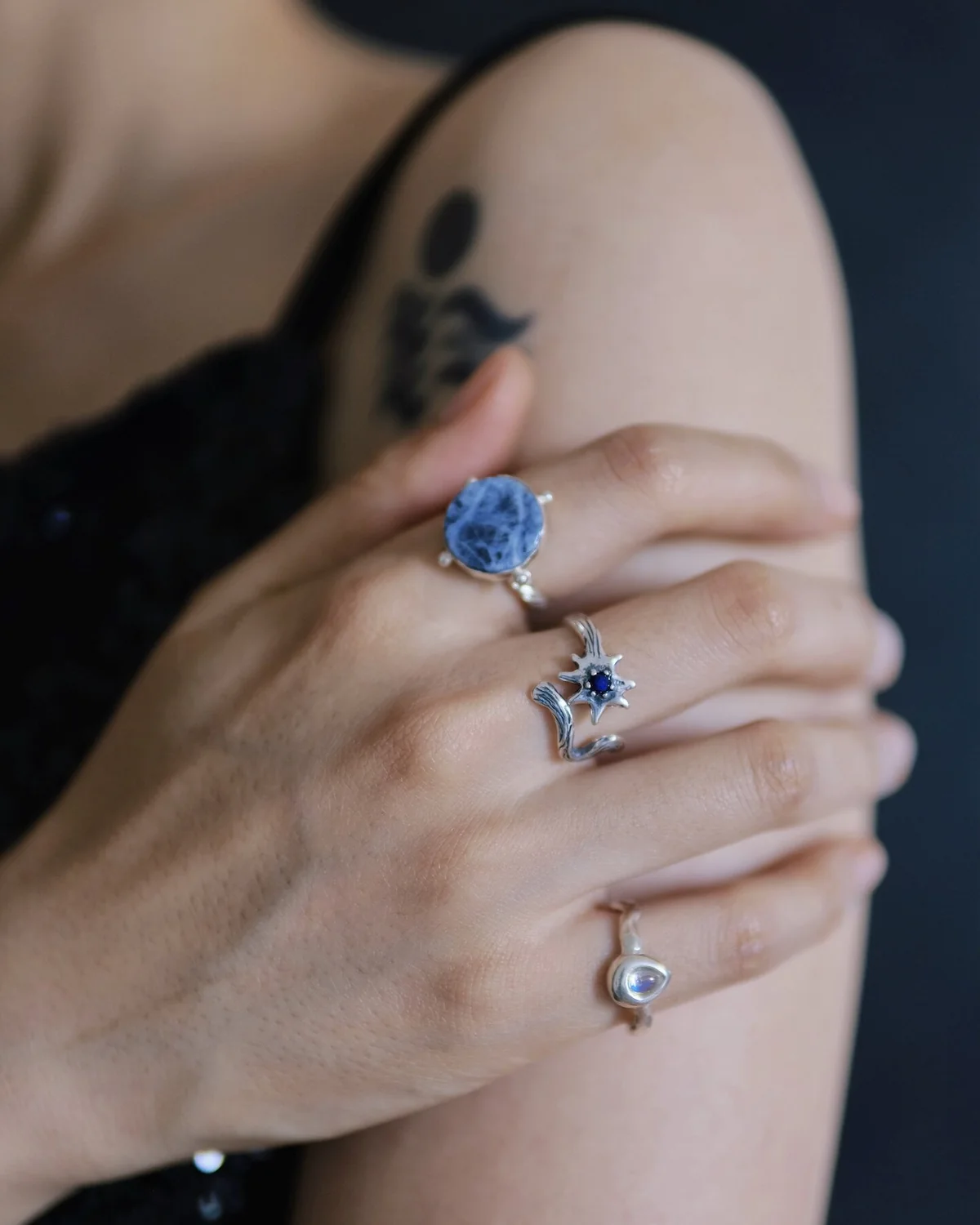
If you are learning how to wear stacking rings, begin with relationship rather than quantity. Think of the process as a match game, not the search for a matching set. Choose one ring with the clearest visual idea. Add a curve, texture, metal tone, or color that answers it. Then leave enough skin visible for every form to keep its own voice.
Handmade rings are especially suited to this way of dressing. Small shifts in line, relief, and polish do not need to be corrected into factory sameness; they can become a more varied language for self-expression. A ring may support a larger composition one day and stand alone the next.
This ring stacking guide is not a set of permissions. Hands differ. Rings sit at different heights. The piece you reach for every morning may matter more than the one that photographs neatly beside it. The point is to notice relationships—and to edit until the arrangement feels intentional, comfortable, and still recognizably yours.
What Is a Stacking Ring—and What Is Ring Stacking?
A stacking ring is a ring worn in deliberate relation to another ring. It may be slim enough to sit above or below a second band, but ring stacking is not limited to piling bands on one finger.
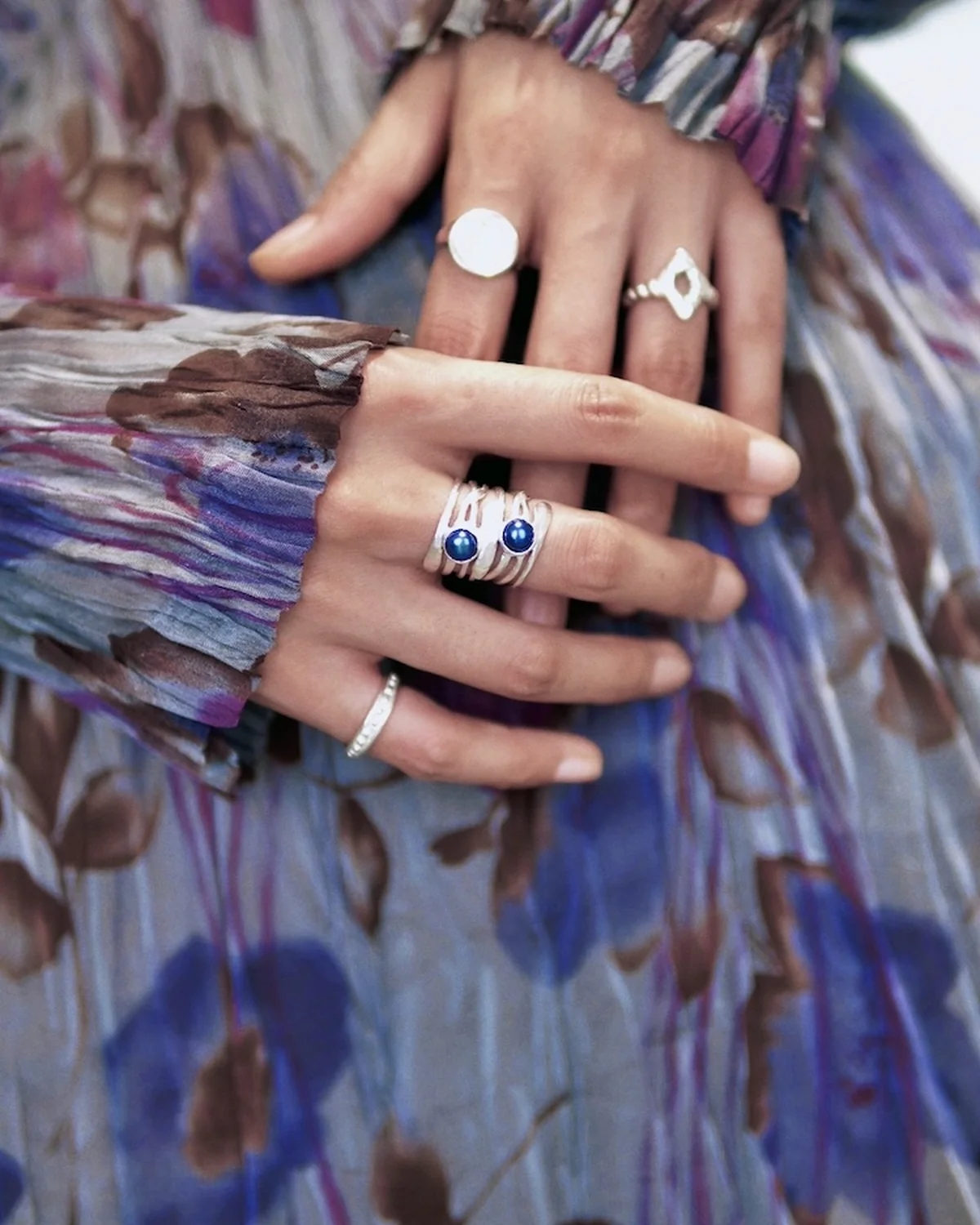
A wide ring on the index finger, a small stone on the middle finger, and a bare ring finger can form a stack across the hand. So can two rings on one finger and a third on the opposite hand. One is a vertical stack. The other is a composition made across several fingers.
This wider definition is useful because it removes the pressure to fill space. It also makes room for sculptural rings, signets, irregular stones, and broad bands that were never meant to sit tightly against another piece.
The three-part structure
Most resolved stacks contain three elements:
- An anchor — the ring with the strongest color, widest face, tallest setting, or most active surface.
- A bridge — a repeated line, curve, metal, texture, or mood that connects the other rings to the anchor.
- Breathing room — bare skin that separates forms and keeps their outlines readable.
The anchor gives the eye a first place to land. The bridge prevents the pieces from looking accidental. Breathing room lets the hand remain part of the composition.
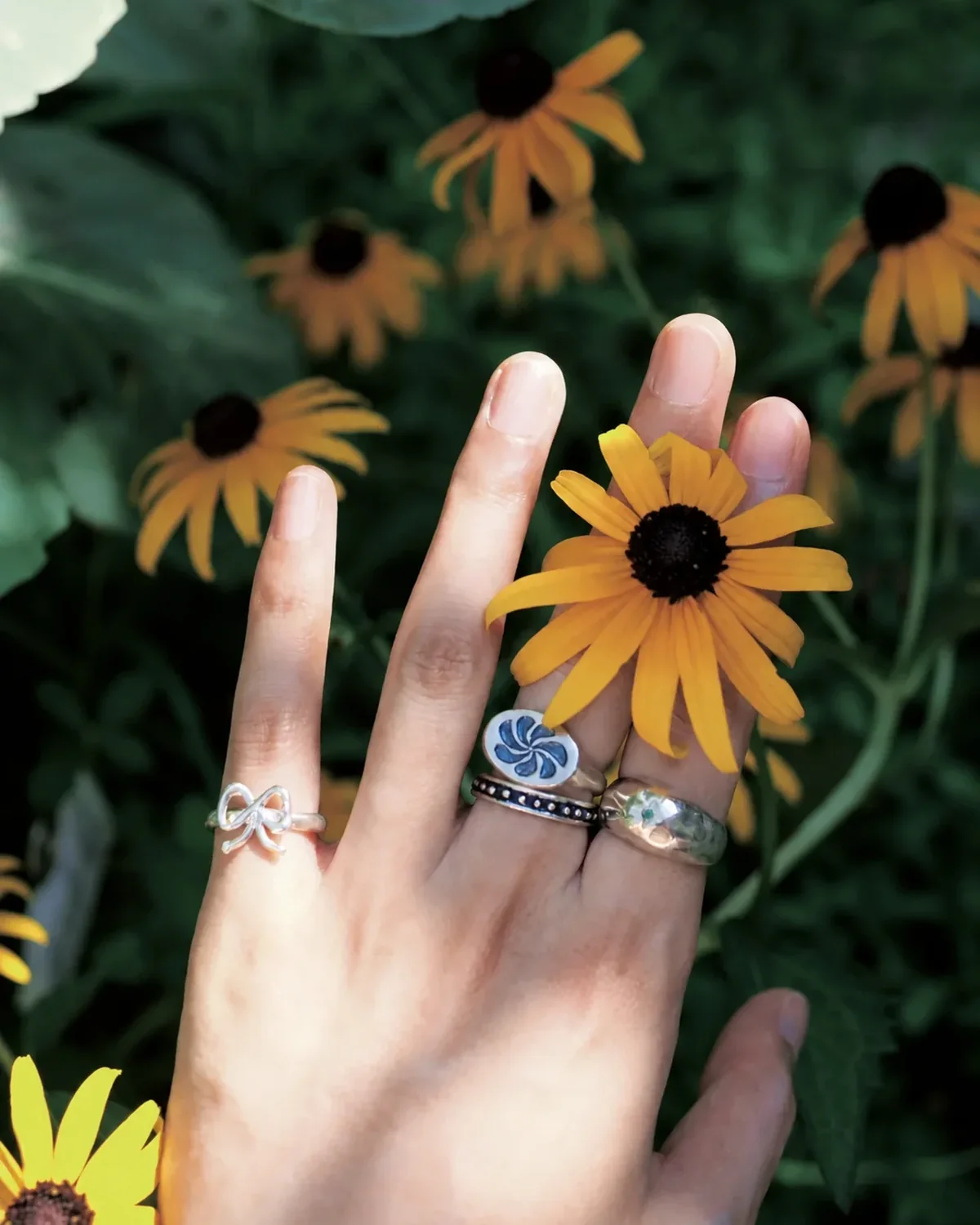
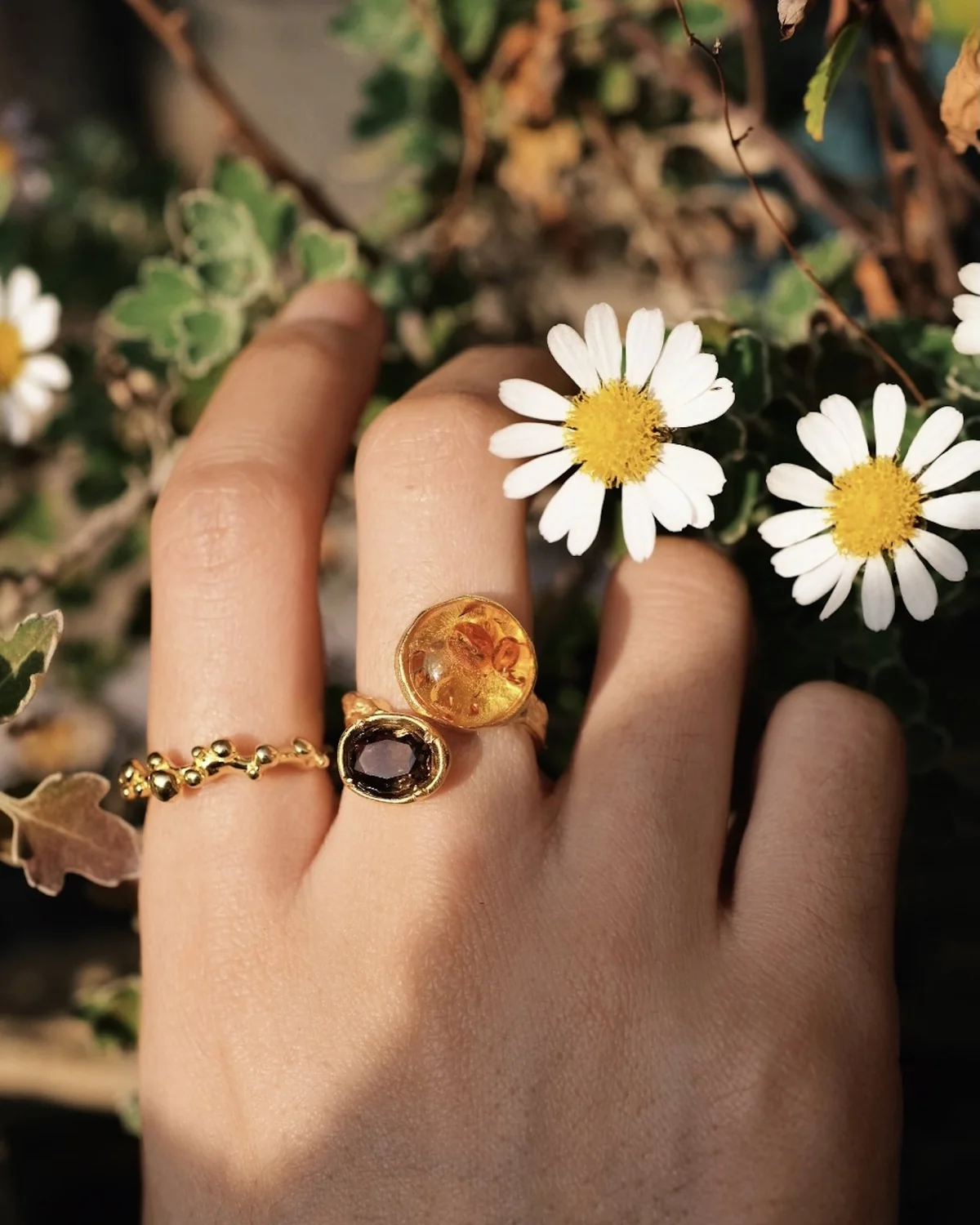
A bridge does not have to be a matching motif. It can be the repeated cool tone of silver or a shared sense of play. In the wildflower image below, the rings change in symbol and width, but the metal keeps them in conversation while the garden carries the mood.
Start with a Visual Anchor, Not Necessarily the Largest Ring
Before adding anything, choose the ring you would still wear if every other piece had to come off. That is usually the most honest anchor.
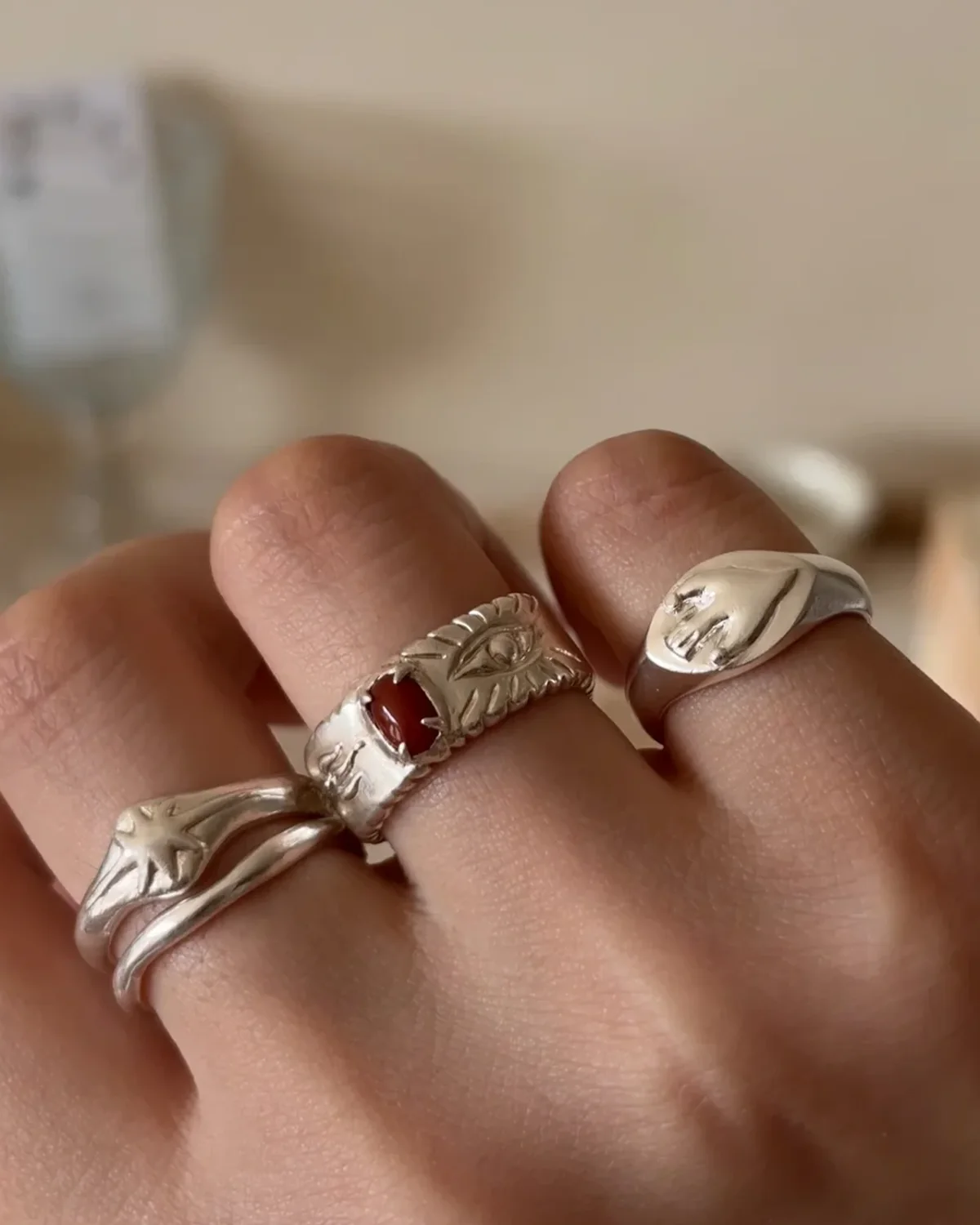
It may be a dark stone with a small face. It may be a broad matte ring that reflects very little light. It may be an irregular setting whose outline changes as you turn your hand. Visual weight is not the same as physical size.
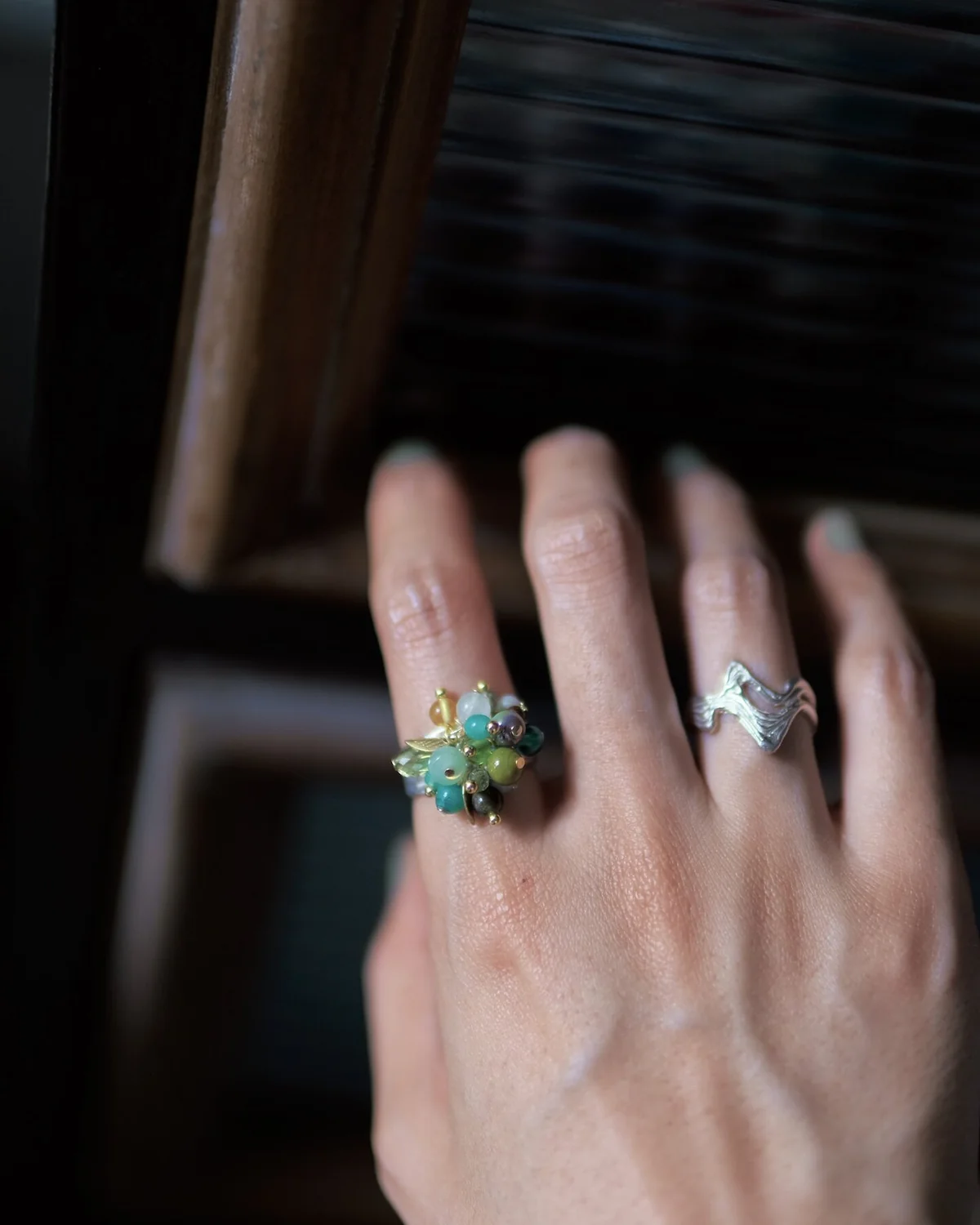
The I Set a Fire red agate ring is a clear example. Its Southern Red Agate is not large, but the color is concentrated and the surrounding 999 fine silver carries relief and shadow. It does not need another red stone beside it. One or two lower, quieter silver lines are enough.
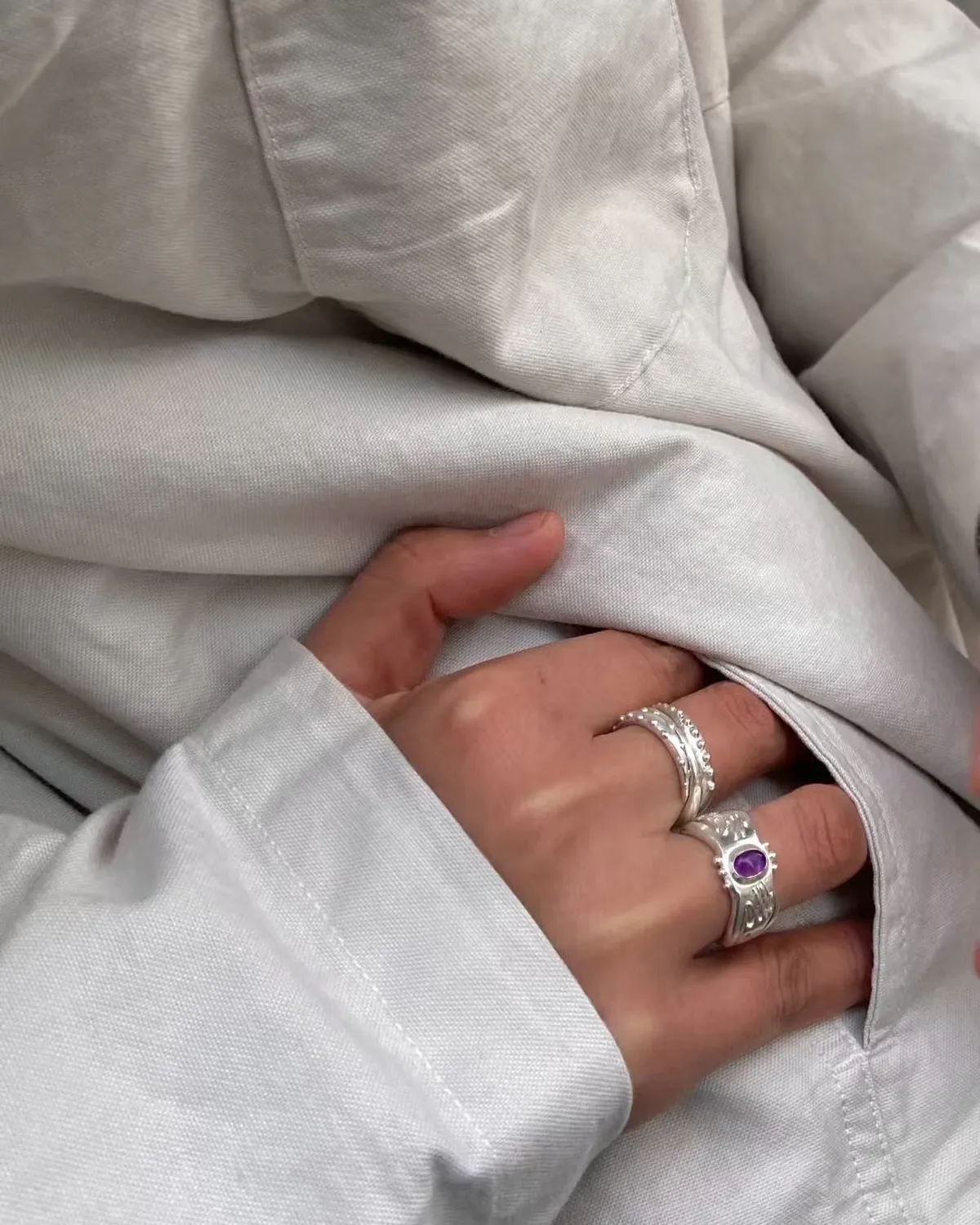
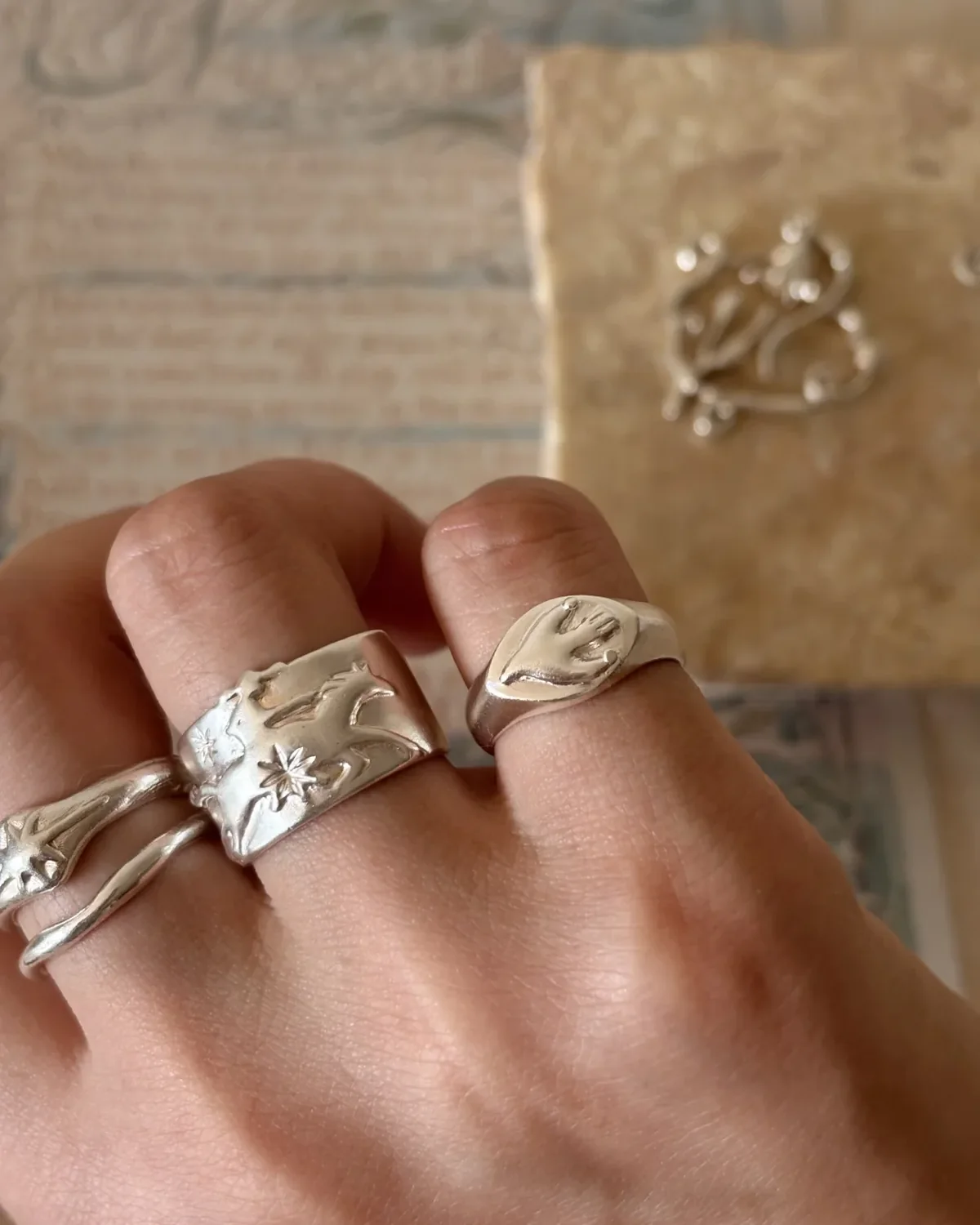
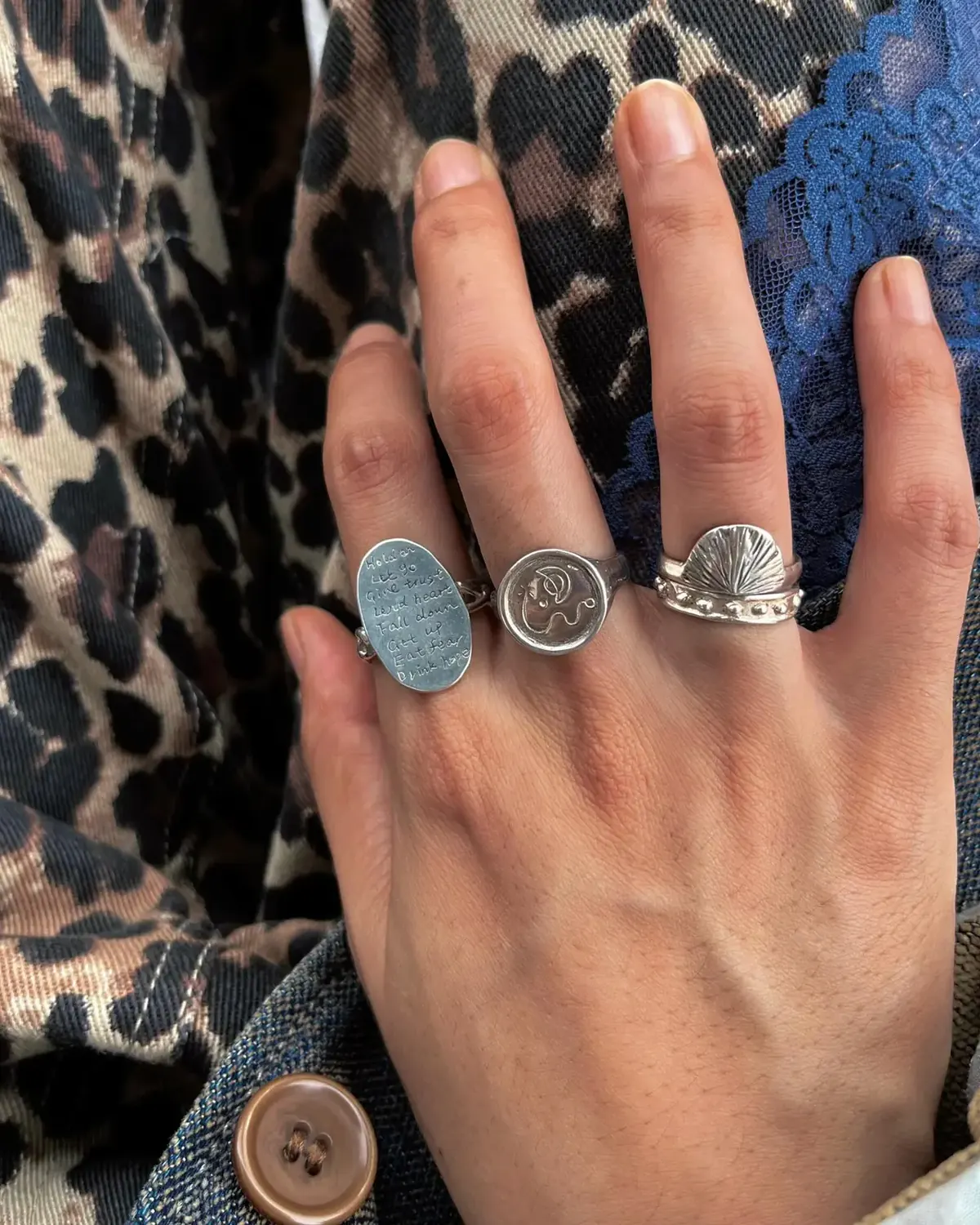
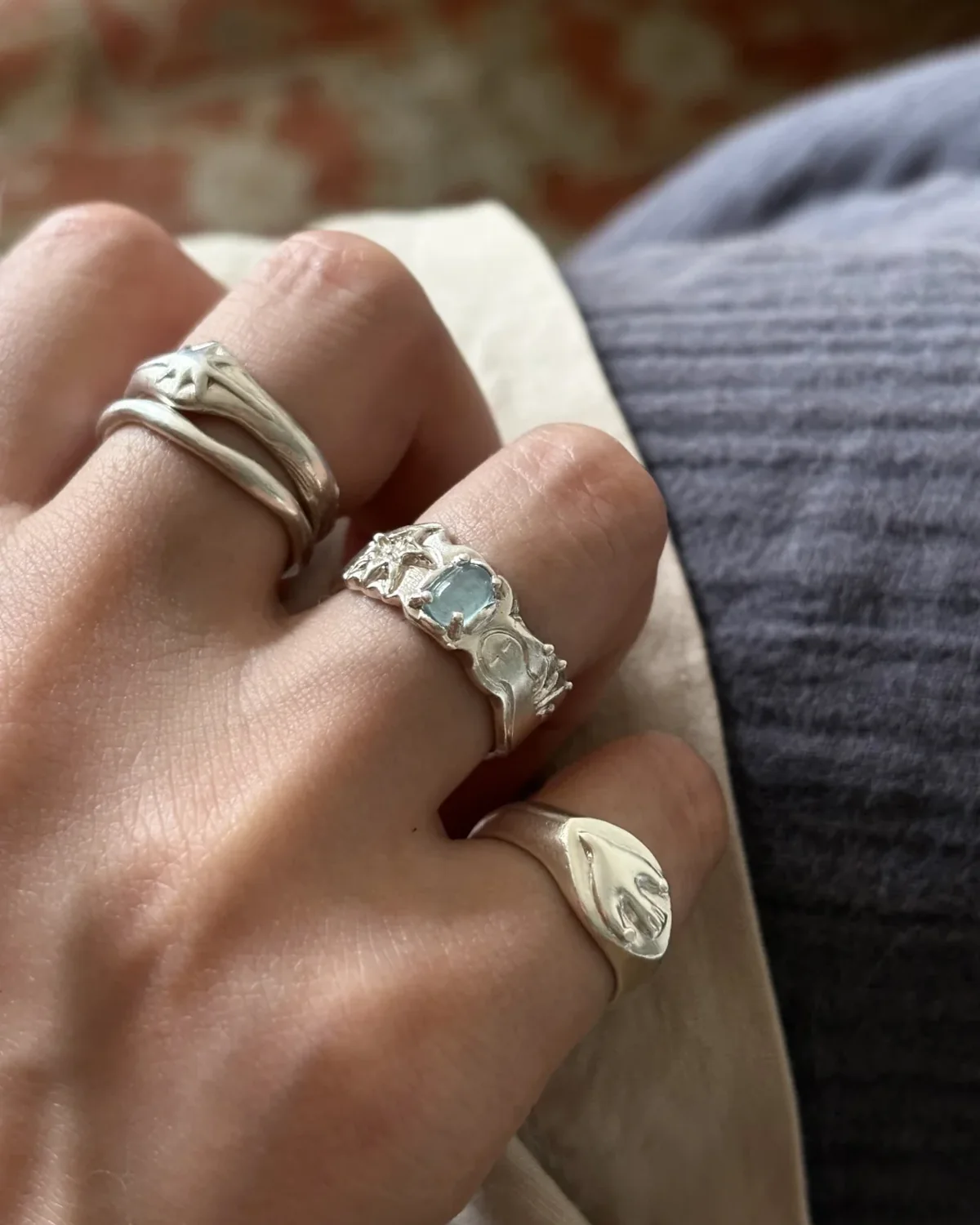
A colored stone is not the only kind of anchor. In the relief-heavy silver arrangement below, broad engraved faces hold light and shadow across their surfaces. Two narrower, more fluid bands break the mass. The eye lands on surface activity rather than color.
When every ring is trying to be the anchor, the hand becomes one dense area. Move one statement ring to the other hand. Replace another with a narrow band. Or leave the neighboring finger bare. Removing a ring is not a failure to finish the stack. It is often the decision that makes the rest visible.
Balance Width, Height, and Surface
The usual advice to “mix thick and thin rings” is useful, but incomplete. Width is only one kind of visual weight.
Look at four things before you add the next ring:
| What to notice | Why it changes the stack | A useful response |
|---|---|---|
| Band width | Controls how much of the finger is covered | Place a slimmer line beside a broad band |
| Setting height | Changes movement and how rings meet at the knuckle | Give a raised stone more room on its own finger |
| Color contrast | Decides where the eye lands first | Let one stone or metal color lead |
| Surface activity | Changes how much light and shadow the ring holds | Pair carving or relief with a quieter form |
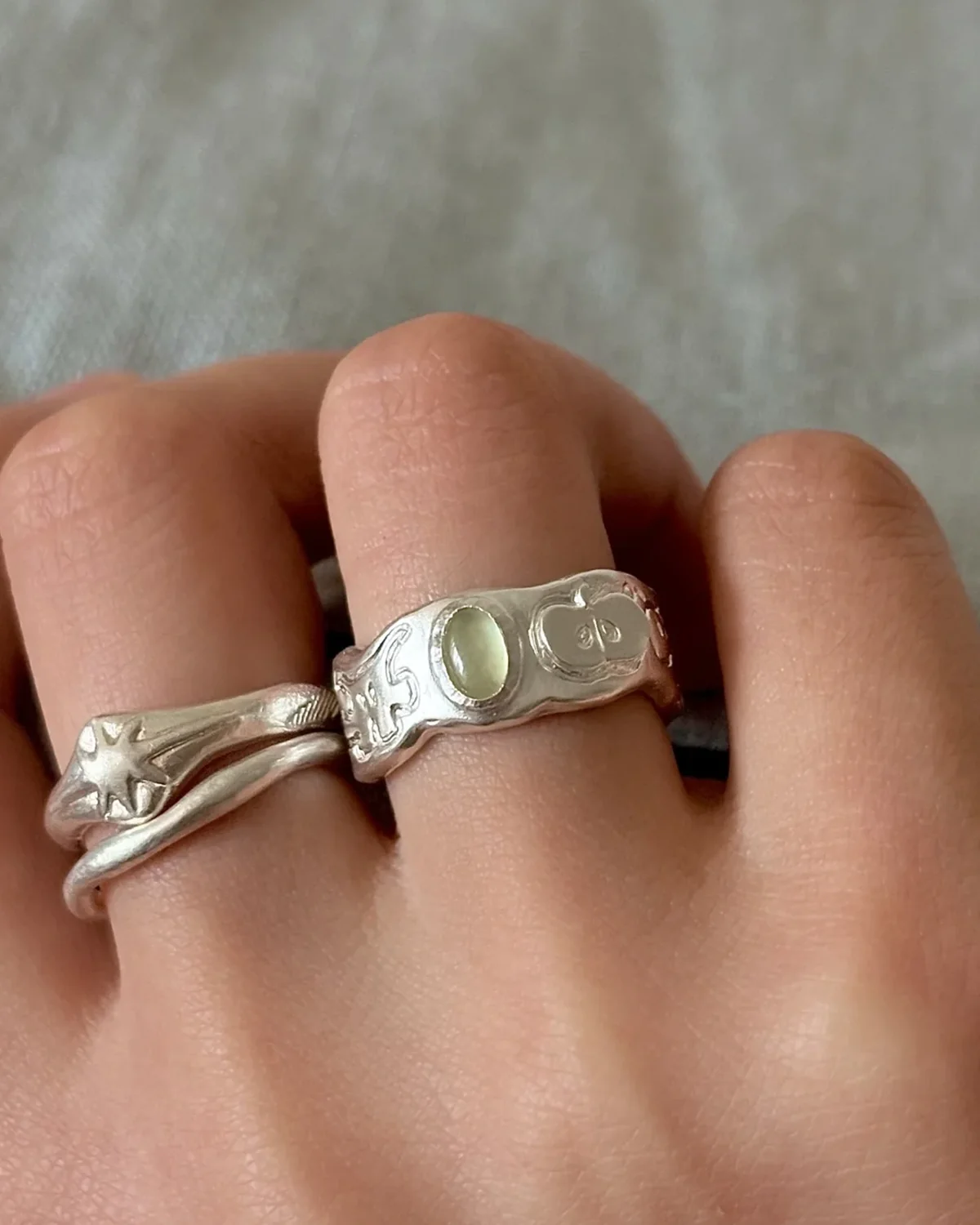
The broad band of the Green Apple prehnite ring carries tiny figures and symbols around its surface. A second wide narrative ring directly beside it would compress both stories. A narrow open line on the next finger gives the carved surface a boundary without closing it in.
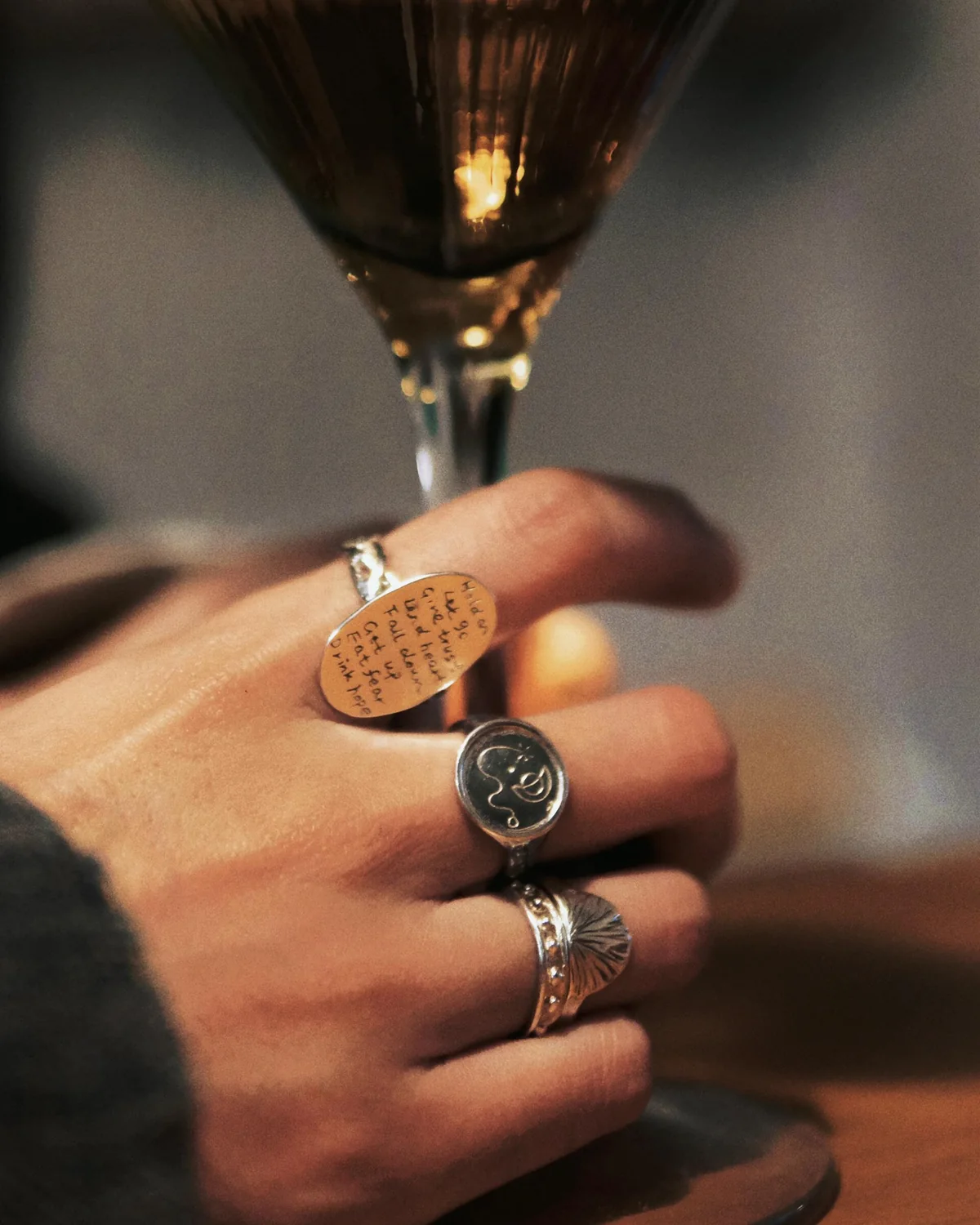
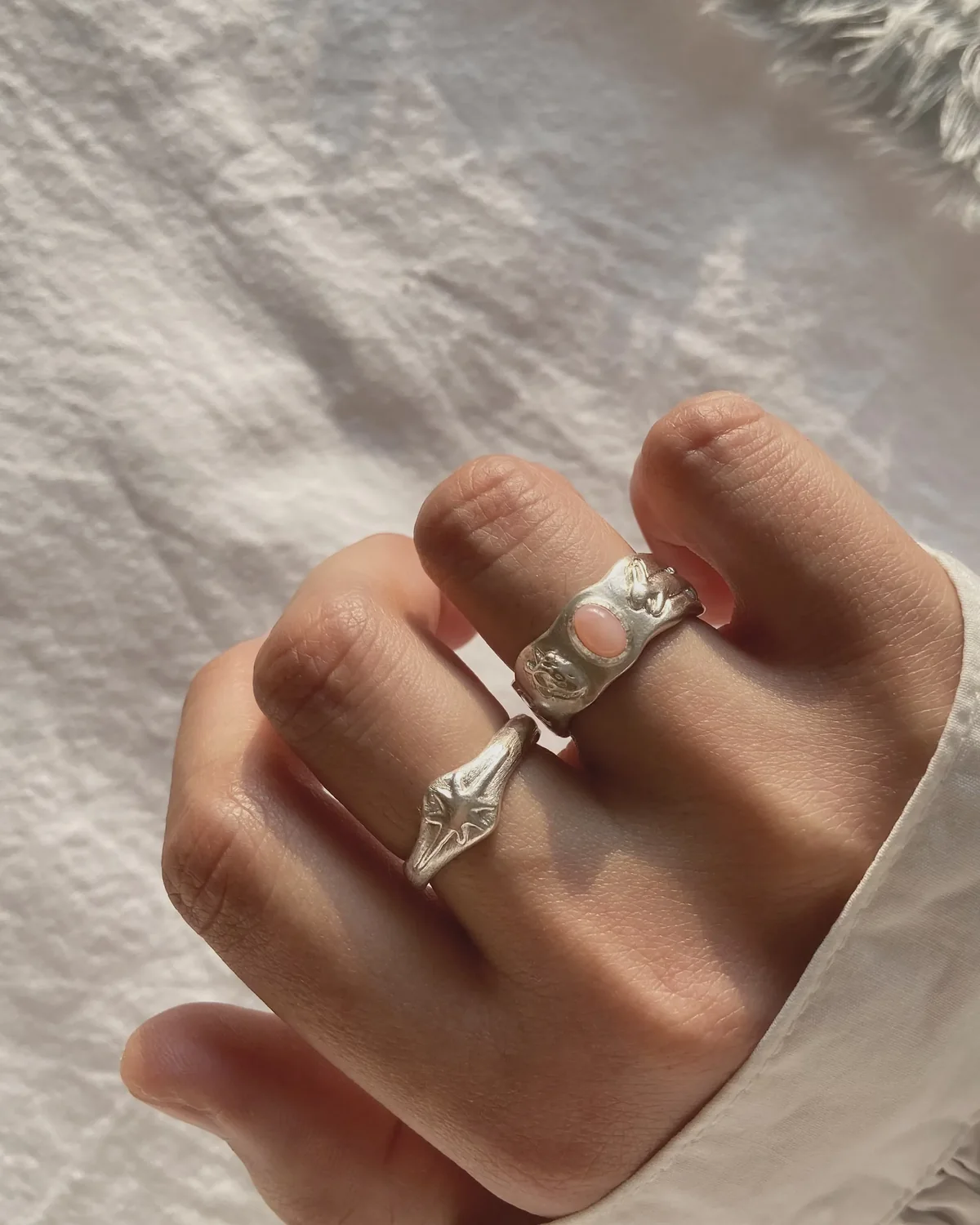
Texture can also act as the bridge. A signet, a radiating carved band, and a small engraved face may have different silhouettes, yet their marks all catch shadow. They belong together because the surfaces reveal a hand at work—not because they came from a matching set. The slight changes in depth and polish are not noise to hide; they are part of the conversation between pieces.
Material matters here. S925 sterling silver is harder than 999 fine silver and suits narrow, open, or precise structures. 999 fine silver is softer and often appears in more substantial, sculptural forms. Neither number is a score. The 925 vs 999 silver guide explains why construction and intended wear matter as much as purity.
How to Stack Rings on Fingers: Compose the Whole Hand
If you are deciding how to wear multiple rings, stop looking at each finger as a separate shelf. Look at the silhouette of the whole hand. This is also where how to wear stacking rings becomes a question of composition rather than counting.
The index and middle fingers sit near the visual center and often carry wider or taller rings well. The ring finger can soften the transition. A low band on the little finger can counter a strong center without creating another focal point. These are tendencies, not assignments; finger shape, knuckles, dominant hand, and daily work matter more than convention.
Begin with the anchor on the index or middle finger. Add one lower ring on a neighboring finger. Then pause. If the two pieces merge into a single block, move the second ring outward or leave a finger between them. Bare skin is not unfinished space. It is what makes the outline of each ring legible.
Balance does not require symmetry. One hand can carry a wider ring while the other carries two narrow bands. A small difference in visual weight often feels more alive than a mirrored arrangement.
Above-knuckle rings can add a second level, but the fit must be secure and the joint must bend freely. Do not use a ring that is too small simply to create the look. The most useful answer to how to wear stacked rings is always the one that lets the hand keep moving.
Mix Metals and Color Without Losing the Thread
Matching every finish can make a stack feel flat. Difference gives it movement. The question is not whether gold and silver are allowed together. The question is what connects them once the color changes.
Use one of three bridges:
- Shape: repeated oval faces, rounded stones, or related curves.
- Surface: engraving, matte areas, irregular edges, or a softened polish.
- Color rhythm: one warm ring as the anchor, with a smaller warm note elsewhere—or one warm ring alone, clearly intentional.
The Narrative Verse Ring is made in S925 silver and is also available in 14K gold vermeil. Its broad, seal-like face carries more weight than a narrow polished band. In gold, it can be the only warm shift in a silver stack. The surrounding pieces do not need to copy its color if their irregular surfaces speak the same language.
Natural stones work in a similar way. A blue or green stone can be answered by a smaller cool-colored detail, but repeating the exact color is not necessary. Often the silver around the stones is enough to hold the composition together.
Five Ring Stacking Ideas You Can Build from What You Own
Good ring stacking ideas are structures, not shopping lists. Begin with the rings already carrying a place in your life, then use these formulas to see what relationship is missing.
1. The fine-line rhythm
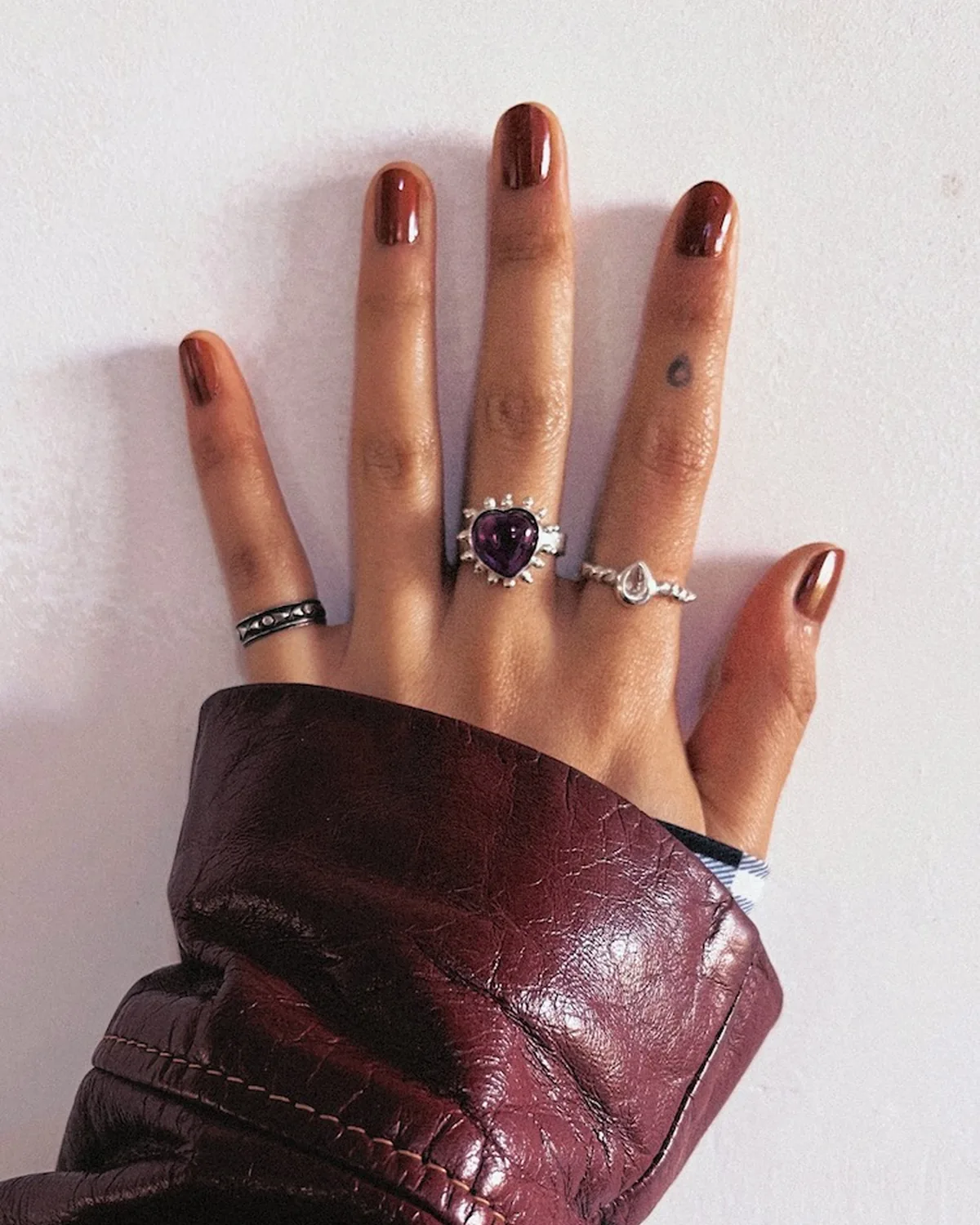
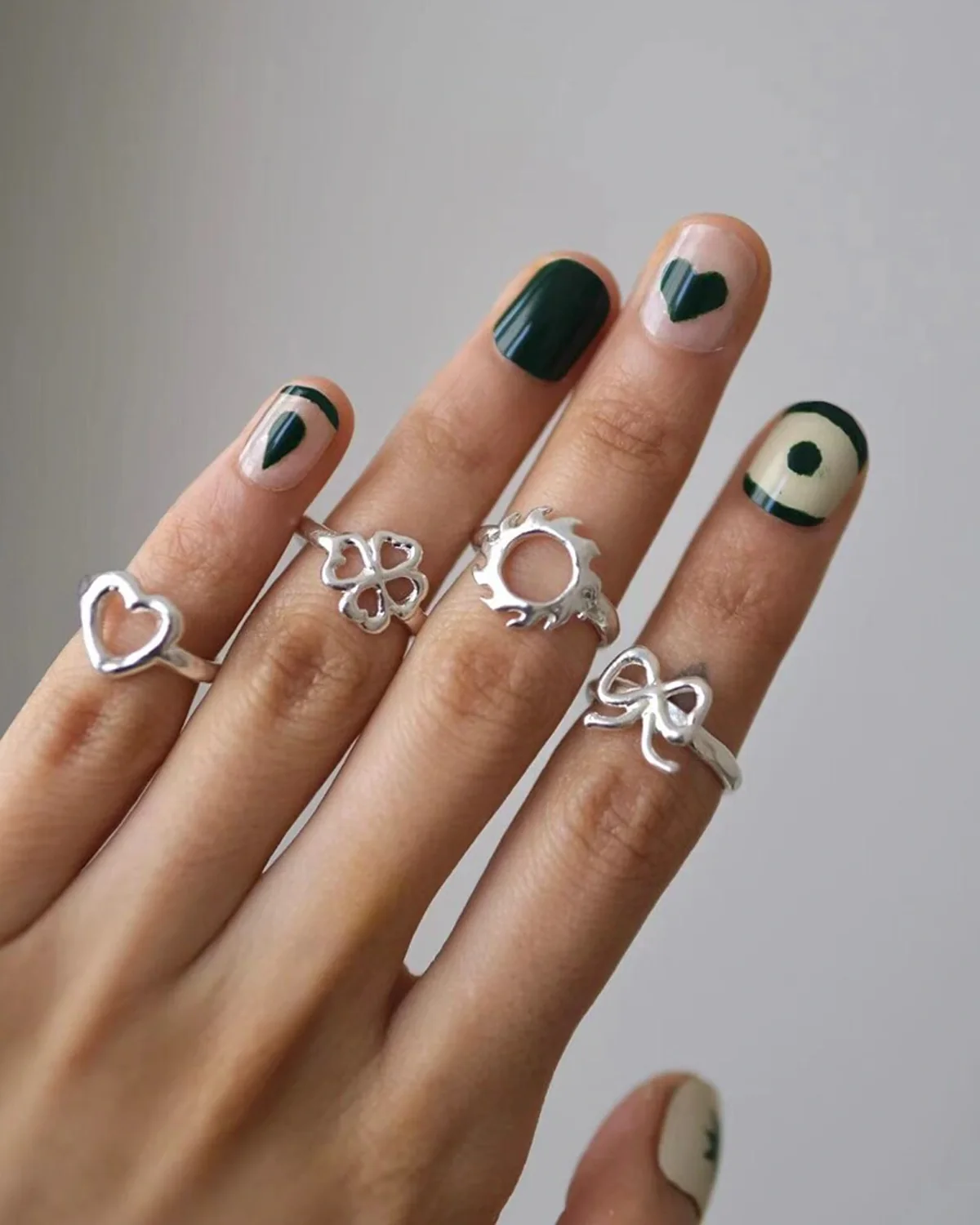
Use two or three narrow bands across neighboring fingers. Repeat the metal and line weight; let the motifs change. The S925 Sterling Silver Stacking Rings use a heart, four-leaf clover, spiral sun, and bow on adjustable open bands, so the rhythm comes from the repeated silver line rather than identical symbols.
2. The stone and its echo
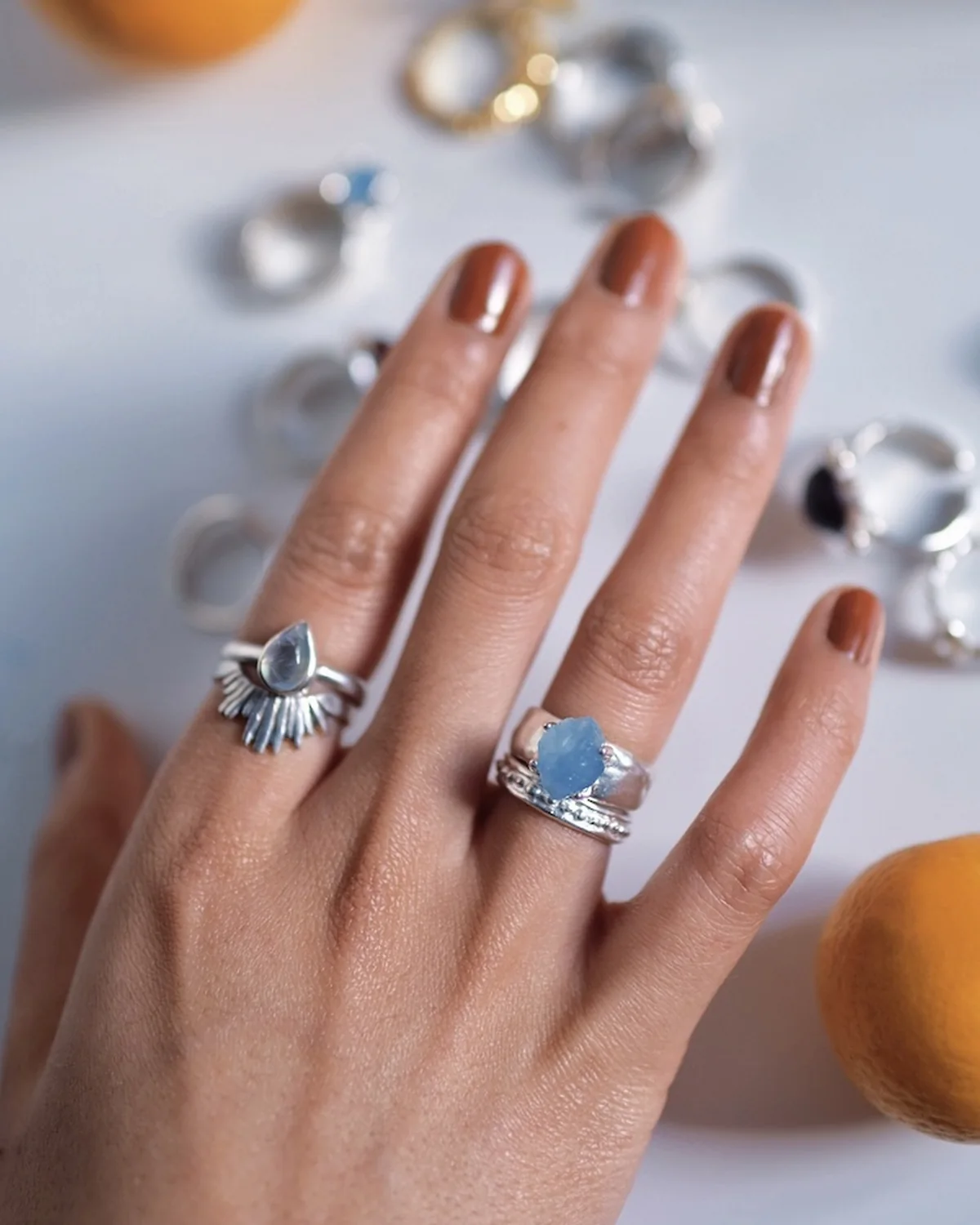
Choose one colored stone as the anchor. Add a smaller stone in a related temperature—cool beside cool, warm beside warm—or let a plain silver band echo the setting’s curve. Keep the second color quieter.
3. The wide ring and the drawn line
Place a carved or broad ring on one finger and a narrow open band on the next. The wide ring carries the image; the slim ring extends its direction. Leave the finger on the other side bare.
4. The mixed-metal hinge
Use one gold-toned ring between two silver forms that share its shape or surface. The warm metal becomes a hinge rather than an interruption. Avoid adding gold everywhere just to make the first gold ring feel justified.
5. The asymmetric hand
Place the strongest ring off-center—on the index or ring finger—then answer it with one smaller ring farther away. The space between them is the bridge. This works especially well with irregular stones whose outlines resist symmetry.
Explore the wider silver ring collection when you are looking for silver stacking rings or a sculptural anchor to answer something you already wear. Look first for a relationship—an edge, a curve, a surface, a space—not for a prearranged set.
Keep the Stack Comfortable
A stack only works if the hand can stop thinking about it.
Open and close your fist. Type a sentence. Hold a cup. Reach into a pocket. Rings that look balanced in a still photograph may knock together, press against the knuckle, or catch because their settings rise to the same height.
Check the contact points where rings meet. S925 sterling silver is harder than 999 fine silver, so a hard edge held tightly against a softer 999 surface may leave contact marks over time. Silver records wear; that is not automatically a defect. But a smooth spacer or a neighboring-finger arrangement can reduce direct rubbing when you want to preserve a carved surface. The Lazesoul silver jewelry care guide explains how to clean textured silver without flattening its finish.
When the rings come off, GIA’s jewelry-care guidance recommends padded compartments or separate boxes to reduce scratching.
Finger size also changes through the day and with temperature. A stack should not be used to force a loose ring into place so tightly that the finger feels compressed. The Lazesoul ring size guide can help you compare an existing ring or finger measurement with US sizing. If you notice pain, numbness, or a change in finger color, remove the rings.
How to Keep Stacked Rings from Spinning
A ring usually spins because of fit, weight, or finger shape. A top-heavy setting can rotate even when its band is close to the correct size. Some fingers are also narrower at the base than at the knuckle. The GIA benchmark for finger and ring sizing notes that a correct fit should pass over the joint without force and settle where the ring will be worn.
Try these adjustments in order:
- Wear the ring alone and see whether it still rotates.
- Place a slim, secure band above it as a ring guard, without compressing the finger.
- Move it to another finger with a slightly different circumference or knuckle shape.
- Use a smooth removable size adjuster for occasional wear, keeping the area clean and dry.
- For a ring worn often, ask a jeweler whether resizing is appropriate.
Do not solve spinning by building a stack so tight that the rings cannot move at all. Stability should come from fit, not pressure.
The Hand Is Part of the Composition
The most convincing stack rarely looks assembled from a formula. It looks accumulated: one ring kept for its stone, another for the line it draws, another because its surface has changed with wear. On a complicated day, arranging these small relationships can offer a moment of order without taking the play out of getting dressed.
Learning how to stack rings is less about adding and more about seeing. Notice where the eye lands. Notice which forms speak to one another. Notice when the hand disappears beneath the jewelry.
Ultimately, how to wear stacking rings is personal: start with the piece that already feels necessary. Add slowly. Turn your hand. Remove what interrupts it.
Space is part of the jewelry too.
Frequently Asked Questions
What are the rules for stacking rings?
There are no fixed rules. A reliable starting structure is one visual anchor, one connecting quality such as line or texture, and visible space between forms. If a ring repeats information without adding rhythm, try removing it.
Which finger should I wear stacked rings on?
Any finger that lets the rings sit securely and move comfortably. Index and middle fingers often carry wider rings well; ring and little fingers can provide quieter counterpoints. Finger shape and daily movement matter more than convention.
How many rings should I stack?
Begin with two or three. Add another only if it changes the composition through width, height, texture, color, or spacing. A two-ring stack can carry more presence than six similar bands.
Can I mix silver and gold rings?
Yes. Connect them through a shared shape, stamped surface, softened finish, or clear color rhythm. One gold-toned ring can be enough; equal amounts of each metal are not required.
Can I stack S925 sterling silver with 999 fine silver?
Yes. Check that adjacent edges are smooth and the rings are not pressed tightly together. Because 999 fine silver is softer, separate the rings across neighboring fingers or use a smooth spacer if you want to reduce direct rubbing. For U.S. terminology, the FTC’s precious-metal guidance explains that a 925 mark means 925 parts per thousand pure silver.
Can wide rings be stacked?
They can, but often work better as an anchor across the hand rather than in a tight same-finger stack. Give a wide or sculptural ring room at the knuckle and use narrower pieces on neighboring fingers.
Why do my stacked rings feel tight later in the day?
Finger size can change with heat, activity, and normal daily fluctuation. Remove rings if they become uncomfortable and rebuild the stack with fewer pieces or more space. A stack should never depend on pressure to stay in place.